
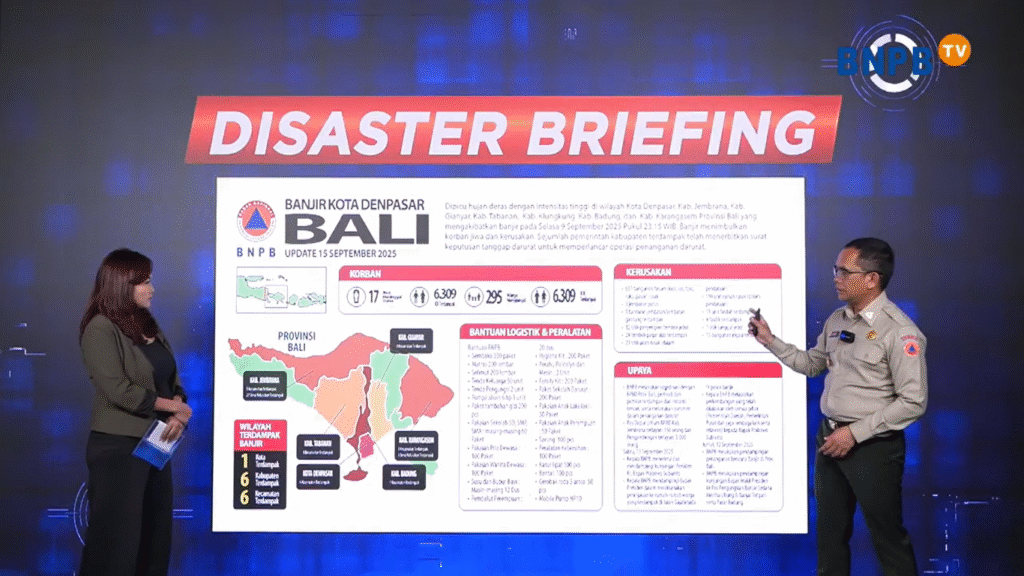
The National Disaster Management Agency (BNPB) has warned that the severe floods that hit Bali in early September 2025 may recur. The agency emphasised the need for improvements in planning and mitigation to reduce risks.
BNPB spokesperson Abdul Muhari explained that large-scale floods have recurrence cycles based on scientific studies and past events. To prepare more effectively, BNPB is gathering historical disaster data to design long-term strategies.
“In civil engineering, we know the term flood repetition period. Some are 50 years old, some are 100 years old. This means that major floods like in Bali yesterday are likely to occur again,” he said in an online conference entitled “Disaster Briefing” which was followed in Jakarta on Monday night.
Scientific Data and Historical Records
To strengthen preparedness, BNPB is currently collecting historical disaster data extending back several years. The agency emphasized that this process is necessary to design accurate long-term mitigation strategies. Abdul also stressed that regional development planning must consider environmental carrying capacity to avoid increasing disaster risks.
“The goal is that tourism in Bali must recover, but we must not forget that disasters do not stop at one event. It will recur, especially if the triggering factors remain,” he said.
Heavy Rainfall and River Overflow
According to BNPB, extreme rainfall raised water levels beyond the capacity of the Ayung River Basin, impacting Badung, Jembrana, Buleleng, Karangasem, Gianyar, Bangli, and Denpasar. Data from September 9 to 10 showed nearly all southern Bali weather stations recorded more than 200 millimetres of rain per day.
BNPB identified this as evidence that Bali is highly vulnerable to hydrometeorological hazards. Casualties and Displacement
The floods left 18 people dead and forced 149 residents to evacuate. BNPB also reported damage to homes and infrastructure in the affected regions.
“We need to make this incident a lesson. Because if a similar condition occurs again, the impact can be just as big or even more,” he said.
Environmental Pressures
Beyond weather, BNPB pointed to waste accumulation and land conversion as factors that worsened flood impacts. Field assessments revealed many riverbanks and waterways clogged with waste, restricting water flow.
“So it is not surprising that the Ministry of Environment has more than 200 tons of garbage carried away by the current, obstructing the flow of the river to cause overflow of water to settlements,” he said.
Land use changes have also reduced natural water absorption. Between 2012 and 2019, Bali lost about 553 hectares of forest and nearly 650 hectares of farmland, much of it converted to built-up areas.
Urban Growth Projections
Spatial studies indicate that built-up areas in Denpasar could expand to 35,000 hectares by 2025, a sharp increase from 2000. BNPB noted that unchecked urban expansion without environmental safeguards may intensify flood risks.
Next Steps
The BNPB emphasised the importance of utilising scientific evaluation and long-term planning to enhance disaster preparedness. The agency urged development policies that account for environmental capacity to avoid repeating the severe impacts of this year’s floods.
“If areas with extreme rainfall are dominated by buildings, then flooding will easily occur. We must return tourism to a balanced ecosystem,” he said.